
Safe Routes to School -Micromobility Resources
CONTENTS -Scroll down for
LINKS to National experts on e-scooter and e-bikes and safety for children
Draft School District Micromobility Policy
Villanova University Micromobility Policy (Reference Model)
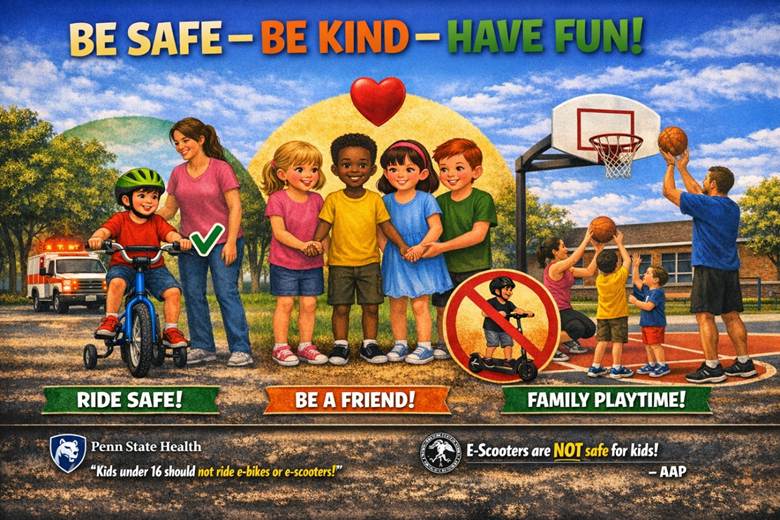
Parent & Student Educational Flyer
Evidence Table: Real‑Time Facts on E‑Scooters
Health Equity Information
Youth Helmet Use & Micromobility Safety: Evidence Summary and Health‑Equity Implications
Safe Routes to School Resources
LINKS to National experts on e-scooter and e-bikes and safety for children
https://kidshealth.org/en/parents/escooter-safe.html
https://www.healthychildren.org/English/safety-prevention/on-the-go/Pages/E-Scooters.aspx
Draft School district policy based on Villanova University policy
Villanova University policy
Parent and Student Educational Flyers
Current 2026 PA State Law on Micromobility
EVIDENCE TABLE : REAL TIME FACTS ON E-SCOOTERS
Universities across Pennsylvania have already determined that e‑scooters are unsafe for adults. They ban them, educate students, and enforce strict rules because of injuries. If adults require education, enforcement, and campus‑wide bans due to injuries, then children in K–12 schools require even stronger protections — and SRTS provides the framework for schools to implement them.
| Claim | Evidence | Sources |
| Small wheels cannot handle cracks/bumps | Small wheels fall into cracks; higher impact angle; greater vertical displacement | Go Grava³; Levy Electric⁴; Transilvania University & Oradea¹ |
| High center of gravity increases tipping | Forward‑pitching moment increases when wheel drops | University multibody model¹; Go Grava³ |
| No suspension increases crash risk | Less air volume = less shock absorption; impacts cause tube pinches | Go Grava³; Levy Electric⁴ |
| Hazards persist at low speeds | Instability is caused by wheel geometry, not speed | University multibody dynamics¹; Go Grava³ |
| Small wheels are structurally vulnerable | High rim stress, crack initiation, accelerated fatigue | Materials (Basel) engineering study² |
| No U.S. safety standards | No federal mechanical, structural, or stability standards | CPSC⁵ |
| Universities ban scooters due to injuries | Villanova full ban; Penn State enforcement action | Villanova Policy⁷; Penn State Police Notice⁸ |
| SRTS requires school‑led safety | SRTS mandates education, engineering, enforcement, evaluation | FHWA⁶ |
Footnotes
1. Radu, A. I., Tolea, A. B., Trușcă, D. D., Ispas, N., & Năstăsoiu, M. (2023). Development of a multibody model used to study the impact between a vehicle wheel and a pothole. Retrieved from https://www.mdpi.com
2. Montassir, S., Moustabchir, H., El Khalfi, A., Vlase, S., & Scutaru, M. L. (2024). Numerical study of crack prediction and growth in automotive wheel rims. Materials (Basel). Retrieved from https://www.mdpi.com
3. Go Grava Adventure Corporation. (2024). Why e‑scooter tires and tubes fail faster than bike tires. Retrieved from https://gograva.com/blogs/guides/why-e-scooter-tires-fail-faster
4. Levy Electric. (2024). Troubleshooting electric scooter wheel problems: A step‑by‑step guide. Retrieved from https://www.levyelectric.com/resources/troubleshooting-electric-scooter-wheel-problems-a-step-by-step-guide
5. U.S. Consumer Product Safety Commission. (2023). Micromobility safety reports and public filings. Retrieved from https://www.cpsc.gov
6. Federal Highway Administration. (2023). Safe Routes to School (SRTS) Program Guidance. Retrieved from https://www.fhwa.dot.gov
7. Villanova University. (2024). Campus Micromobility Ban — Public Safety Policy. Retrieved from https://www1.villanova.edu
8. Penn State University Police. (2024). Micromobility Enforcement Action and Student Conduct Referral Notice. Retrieved from https://police.psu.edu
Youth Helmet Use & Micromobility Safety: Evidence Summary and Health‑Equity Implications (Ages 16–21)
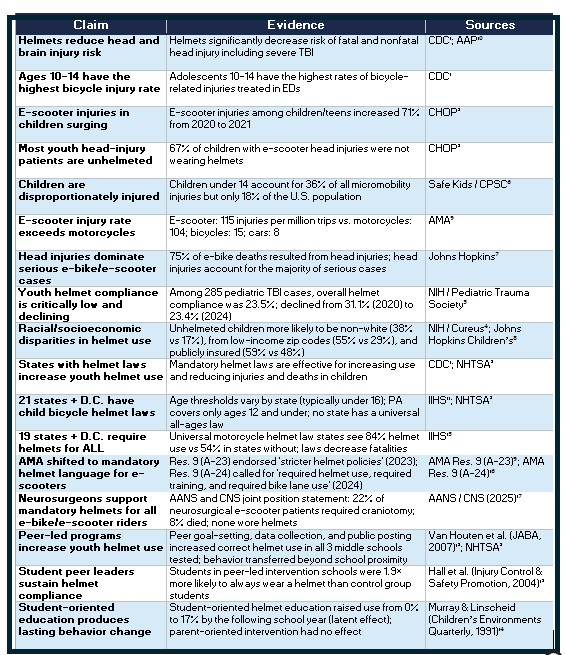
Micromobility injuries among youth are rising sharply in Pennsylvania and nationwide. Helmet use remains critically low among adolescents and young adults, especially ages 16–21. This pattern is strongly influenced by adult behavior, peer norms, and gaps in state helmet laws. These factors create predictable and preventable health‑equity disparities affecting Pennsylvania youth.
If Bike are to share the road and cars have extensive safety requirements for all in them, should Bikes, e-bikes and any v not have have safety standards for all?
Footnotes
- CDC. (2025). Bicycle Safety Fact Sheet.https://www.cdc.gov/pedestrian-bike-safety/about/bicycle-safety.html
- CHOP. (2023). E-Scooter Injuries in Kids and Teens. Presented at AAP National Conference. https://www.chop.edu/news/e-scooter-injuries-kids-and-teen
- NHTSA. (2021). Bicycle Safety — Countermeasures That Work. https://www.nhtsa.gov/road-safety/bicycle-safety
- Ghobrial, G.M. et al. (2023). Social Disparities in Helmet Usage in Bicycle Accidents Involving Children. Cureus / PMC. https://www.ncbi.nlm.nih.gov/pmc/articles/PMC10430888/
- NIH / Pediatric Trauma Society. (2025). Headed for Trouble: Trends and Disparities in Helmet Use Among Pediatric Riders.
- CPSC. (2023). Micromobility Products-Related Deaths, Injuries, and Hazard Patterns 2017–2022.
- Johns Hopkins Bloomberg School of Public Health. (2024). Evidence Synthesis on E-Bike and E-Scooter Injuries, Safety Interventions, and Policies.
- Johns Hopkins Children’s Center. (2026). Disparities in Incidence and Severity of Electric Scooter Injuries in Children. Injury.
- AMA. (2023). Resolution 9 (A-23): Reducing the Risk of Danger Associated With E-Scooters.
- AAP. (2022). Helmet Use in Preventing Head Injuries. Pediatrics, 150(3).
- IIHS. (2025). Bicycle Helmet Use Laws by State.
- Van Houten, R., Van Houten, J., & Malenfant, J. E. L. (2007). Impact of a Comprehensive Safety Program on Bicycle Helmet Use Among Middle-School Children. Journal of Applied Behavior Analysis, 40(2), 239–247.
- Hall, M., Cross, D., Howat, P., Stevenson, M., & Shaw, T. (2004). Evaluation of a School-Based Peer Leader Bicycle Helmet Intervention. Injury Control and Safety Promotion, 11(3), 165–174.
- Murray, R. D. & Linscheid, T. R. (1991). Effectiveness of Bicycle Helmet Safety Intervention in Schools. Children’s Environments Quarterly, 8(3/4).
- IIHS. (2025). Motorcycle Helmet Use Laws. https://www.iihs.org/research-areas/motorcycles/motorcycle-helmet-laws-table
- AMA. (2024). Resolution 9 (A-24): Endorsing More Stringent Measures to Minimize Injuries as a Result of the Widespread Use of E-Scooters.
- AANS & CNS. (2025). Position Statement on Safety of Electric Bicycles and Scooters. https://www.aans.org/advocacy/articles/neurosurgery-position-statement-on-safety-of-electric-bicycles-and-scooters/
Safe Routes to School Resources
PA WalkWorks Program: Samantha Pearson, Healthy Communities Program Manager — https://padowntown.org/
Safe Routes Partnership: Kori Johnson, Program & Engagement Manager — www.saferoutespartnership.org
PennDOT : Consultant Project Manager: Joe Banks, Delaware Valley Regional Planning Commission — www.dvrpc.org
FEDERAL SAFE ROUTES TO SCHOOL –https://www.fhwa.dot.gov/environment/safe_routes_to_school
PA Safe routes to school https://www.pa.gov/agencies/penndot/research-planning-and-innovation/transportation-alternatives-set-aside-program/safe-routes-to-school
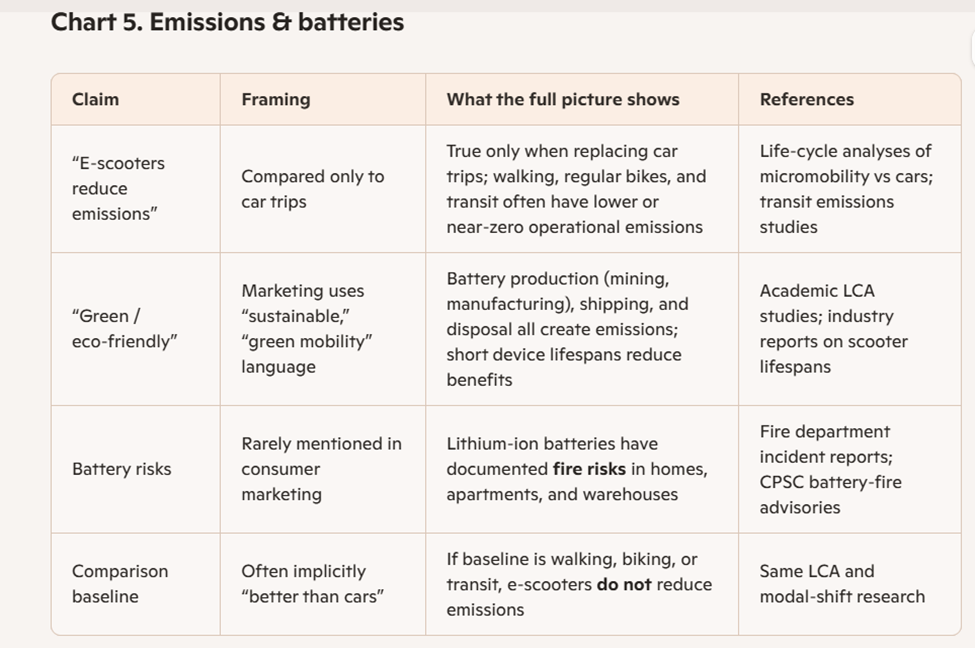
Information on sustainability
Information of worldwide adoption of current e-scooters
| Talking point | What happened | Safety reality | References |
| “Cities worldwide use e‑scooters” | Bird (USA) introduced electric scooters to Paris in 2018. Paris was one of the first major European cities where Bird launched its shared e‑scooter fleet. Many cities launched rental programs quickly after Paris | Several later restricted or banned them after injuries, clutter, and public backlash | Paris referendum ending rentals (2023); Copenhagen, San Francisco, Nashville policy changes |
| Adoption is assumed = safety | Presence in a city is treated as endorsement | Many cities adopted first, then added speed caps, geofencing, parking rules, or removals after problems | Municipal regulations and pilot evaluations |
| UK example | Private e‑scooters remain illegal on public roads; only limited rental trials | National government has not granted full road‑legal status | UK Department for Transport guidance |
| Pennsylvania | Did not legalize e‑scooters on public roads, sidewalks, or paths because low‑speed electric scooters were not recognized as allowed on roads and classified as motor vehicles in the Commonwealth of Pennsylvania, a temporary state authorization was granted in 2021 in Pittsburgh. This authorization expired in July 2023 | Aligns with a safety‑first approach, especially given rising injuries elsewhere Did a trial in Pittsburgh but ended it , this caused some misinformation from the trial to circulate. | PA Vehicle Codes; State Police and Forks Township statements in LehighValleyNews article PA Legislation |
| , South Africa | Introduced by retailers and importers such as Xiaomi, Ninebotand generic Chinese 16+ may ride 125cc or lower scooters with a Code B license • 17+ may ride larger scooters with a Code A1 license • 18+ may ride any motorcycle with a Code A license • | Protective gear is mandatory, yet often not used • Underage riders face significantly higher injury risk | Code A1 Small Motorcycle Licence (2026) |
Micromobility and childhood obesity
| Topic | Fact | Evidence / Reference |
|---|---|---|
| Required physical activity | Children need at least 60 minutes of physical activity daily | CDC Physical Activity Guidelines for Children |
| Walking to school | Walking is a major contributor to daily activity for children in walkable zones | CDC “Active Transportation to School” |
| PA school expectations | Young children in walkable areas are expected to walk; buses are provided for non‑walkable zones | PA School Code; PDE transportation guidance |
| What children are actually doing | Children are using e‑scooters/e‑bikes for joyrides, not transportation and underage children are picking up elementary students on e-scooters and e-bikes | LehighValleyNews article: police report kids riding at night, in groups, “playing in traffic” Direct reports and observations in communities |
| Physical activity replacement | Riding powered devices does NOT provide the physical activity benefits of walking or biking | CDC & AAP guidance on active transport |
| Impact on obesity | Reduced walking time is linked to higher childhood obesity risk | CDC & AAP obesity prevention research |
| Recreation vs transportation | For young children, micromobility is being used as recreation, not a transportation need or providing physical activity | Police statements; PA School Code |
| Safety + obesity link | Children are replacing safe, healthy walking with dangerous, sedentary joyrides in traffic, playgrounds and sidewalks, that AMA says are not developmentally appropriate to handle and can injure other children | Combined evidence from CDC + LehighValleyNews article Penn State Health News /17671-2/ |
Talking points “Affordable,” “Last Mile,” and Alternatives to stand up e-scooters
| Claim | Fact‑Check | Evidence / Reference |
|---|---|---|
| “Affordable transportation” | Only if ignoring medical costs; walking and regular bikes are cheaper, short life span and fire risk, | CPSC injury data |
| “Last‑mile solution” | Teen, adults can use other means or walk Young children should walk or take buses, Bikes for delivering and usually multiple delivers are being done | PA School Code |
| “Needed for speed” | Rush culture is causing safety problems (passing school buses, speeding) | Traffic safety campaigns |
| “Reduces emissions” | Only when replacing car trips; and does not consider disposal or short lifespan, walking/biking produce zero emissions | LCA studies |